Tag: traumaprevention

  • Why Supporting Your People is Essential to Your Business

    Why Supporting Your People is Essential to Your Business

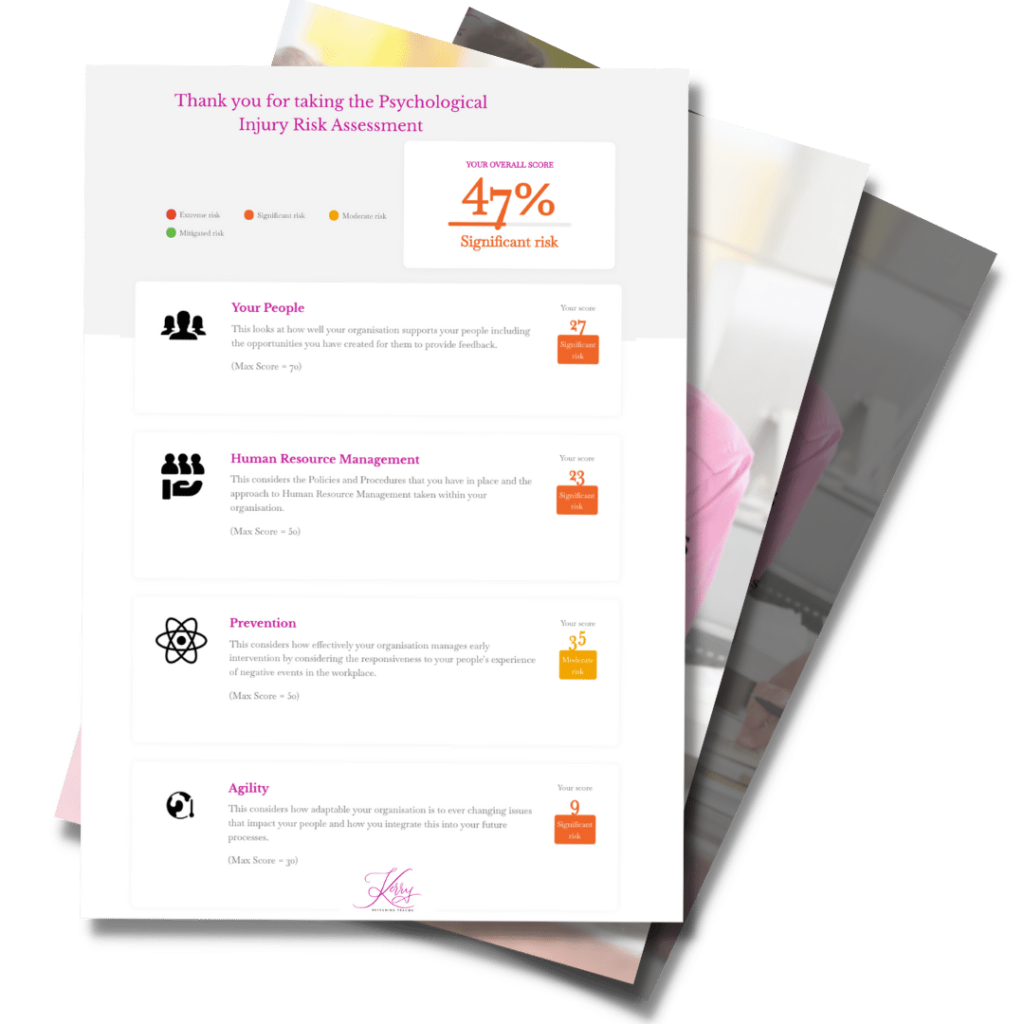
    When we are trying to mitigate risk for psychosocial injuries in our business, it is essential to know how your organisation supports your people. It is crucial to your business success that you do. This includes looking at the opportunities you have created for them to provide feedback.

    When assessing your risk for psychological injuries, we include questions about ‘Your People’ in our scorecard assessment. It is important to understand how you engage with your people and look at the avenues you have to obtain feedback about how they feel working for your organisation.
    Gain Insights Through Anonymous Feedback

    It is a useful component to your strategy to obtain anonymous feedback, in addition to other forms of feedback. Asking your people for feedback in a way that enables them to be anonymous provides us with great insight into what they think. The opportunity to be anonymous enables people to feel more confident and tell you their true feelings, as they feel protected by the anonymity. Staff Survey’s are usually anonymous, but your staff survey should never throw you any ‘curve ball’ surprises!

    In addition to formal anonymous surveys, you need to provide informal ways of getting the pulse of your organisation on an ongoing basis. This includes multiple open lines of communication that allow people to report concerns in multiple ways. All organisations need reporting processes that are broader than the immediate line manager, especially if the line manager is part of the issue.

    We also look into the ‘hidden’ indicators of dissatisfaction, including rates of unplanned leave and capturing information about workers compensation claims. This should include all claims, regardless of whether they are for a physical or a psychological injury.

    By assessing rates of leave, we can examine any patterns that may indicate a problem in a particular team or area of your organisation. There is a lot of data in varying systems within your organisation that can be consolidated into an early warning system – the data doesn’t lie.

    Presenteeism

    The other measure of dissatisfaction is presenteeism, people not being focussed or productive. If you have ways of measuring output, regularly monitoring these will give you insight into an underlying feeling of discontent.

    Most work areas will have KPIs, and depending on the work, there are expectations of output. However, depending on the type of work that your business delivers, it can be more challenging to observe lost productivity. At some point, it can be useful to benchmark the time that varying tasks take, so that we can have clear expectations regarding output.

    Taking the time to assess output is something that many organisations claim that they “don’t have time” to do. However, as your organisation starts to expand, it is essential that each new role has clear duties and expectation targets for each task. Each role needs to have a clear goal and link into the overall strategic direction of the business, the goal needs to be clear even if the pathway to achievement isn’t yet clear.

    A lack of clarity and ownership of the outcomes is guaranteed to create presenteeism in any organisation.

    Exposure to Risks and Workers Compensation

    If your rates of workers compensation claims are high, do you look at if there are any commonalities? Either particular sections or people in the organisation that are exposing you to more risk? Are there particular work types in your organisation that appear to be a higher risk?

    It’s important to know that regardless of the source of the injury, a person can develop a secondary injury if things are not well managed. A physical injury that results in a person being isolated from the workplace, or ostracised in any way, can result in a psychological injury – so these need to be effectively managed.

    We have access to a lot of data about our people, but we don’t think about synthesising it to provide us with an early warning system about their health and wellbeing.

    Managing Difficult People

    Our people are the number one asset in our business. If you fail to look after them you will find it challenging to grow. From making better choices in recruitment processes, to responding quickly to mediate challenges between staff members, there are several areas that we can manage better to reduce the risk of needing to manage difficult people.

    I often hear managers lament the time it takes to manage ‘difficult’ people, but perhaps they wouldn’t become problematic if we worked things better. Especially after the past two years of the pandemic, looking after our most significant resource should not be viewed as a chore – it’s essential to the success of your business.


    Want to know if your business is at risk? Take our assessment and see your scorecard today.
    Reframe . . . Respect . . . Recover!

  • Validation

    Validation


    validation
    /valɪˈdeɪʃ(ə)n/ – the process of learning about, understanding, and expressing acceptance of another person’s emotional experience

    One of the conversations I often have with organisations is about validating the experiences of their employee’s.   When conflict in the work environment leads to one person taking stress leave, it is important to validate the stressed person’s perspective, regardless of who or what has resulted in the conflict.

    The issue is not about who is right and who is wrong.

    The problem is that our society takes a legal approach to validation, we often want to find one person is right and one person is wrong.  It is actually this approach that causes the biggest problem, because rather than accepting a person’s perspective of a given situation, we seek to overlay our own perspective.  This approach isn’t helpful.  In reality, if a person perceives that they are in a situation in which they are so stressed that they cannot be in the workplace, then we just need to validate that person’s experience.

    One of the biggest challenges in HR areas and injury management units is that we often put ourselves in that person’s shoes and try and decide whether we agree that they should feel that way or not.  It’s human nature.  However, it is not our role or place to do so.

    It is not appropriate for us to decide whether or not we agree with that person’s perception.  Their perception is exactly that – it’s their perception, and we have to manage that.

    In order to move forward and attain a solution for the person’s stressful experience, it is essential that we validate a person’s it, regardless of how we believe that we might feel in those same circumstances.  In reality, we can not actually determine if we would feel as stressed as this person is saying that they are, because we are not them.

    Our role is to support them in what they are telling us they feel.  We don’t have to agree with whether we would feel that way ourselves in the same situation or not.  It seems unreasonable that we are so used to judging people and trying to put ourselves in another person’s position to determine if that would be how we would feel.

    It is not about you or your experience – it is about them and their experience.

    The key to actually engaging stressed workers and getting them back to work quicker has to do with validating how they are feeling about their experience, just as they communicate it to you.

    It is really hard as human beings to pull back from putting yourself in another person’s position.  To show empathy we always say “You have to walk a mile in someone else’s shoes”.  In certain circumstance, yes, we absolutely do.  However, we should not if it means that you’re going to invalidate the experience that they’re telling you they are having.

    To be solutions focussed we first require a clear understanding of the problem – listen and understand THEIR perspective.  Then ask them to help you resolve the problem for them and give them what they ask for.  If that is a temporary reassignment to a different work area – do it.  This will allow them to Recover At Work (RAW).  Maintaining their engagement in the work environment, in any capacity, will reduce any likely workers compensation claim and improve their chances of a speedy recovery.

    It may seem like a really simple thing, but you would be surprised at how many problems are caused in organisations because we judge somebody else based on our own experiences. 

    And in reality, we don’t have any right too.

    Reframe . . . Respect . . . Recover!

  • Mental Fitness

    Mental Fitness


    mental fitness
    /mɛnt(ə)l fɪtnəs/ – a personal framework for understanding how to build wellbeing and having a positive sense of how we feel, think and act

    It has only been over the past decade that I have focussed more on my physical fitness, to assist with my health and wellbeing, and manage my injuries.  Going to the gym multiple times a week helps me to gain and maintain strength and reduces my pain experience from injuries that I sustained over 15 years ago. 

    In order to be accepted into frontline service organisations, you must be physically fit.  There is an expectation that you will maintain fitness even as you get older, as it is always expected you can meet certain minimum fitness criteria.

    This is perfectly understandable considering the role itself requires quite a lot of physical fitness.  When fighting a fire, you may have to stand with the hose for lengthy periods of time.  Or as a paramedic, you may have to lift someone onto a gurney.  Police officers may have to chase a perpetrator down.  We know that these roles require a certain level of physical fitness.

    However, we also know that these roles expose individuals to traumatic experiences, leaving them in a place of psychological vulnerability.  We participate in physical fitness, requiring minimum standards and ongoing work to maintain them.  So, why don’t we also practice mental strengthening exercises?  Training and regular exercises that support us to understand our risk from exposure to traumatic events and how to minimise this risk.

    We need to provide individuals with a mental skills toolbox!

    To support physical fitness capacity, we usually follow a program.  We have personal trainers; we watch what we eat and how we sleep.  We can engage in high energy activities like High Intensity Interval Training (HIIT) or lower intensity exercise like Yoga or Pilates.  There are a variety of forms of exercise that can improve and maintain physical fitness and we know that these roles require a minimum level of fitness and we require people to maintain that in order to stay in the job.

    We know that people in certain industries are going to end up with psychological challenges because of the work they do.  What we don’t seem to understand is that there is a range of mental fitness exercises and tools that they should engage with post exposure. 

    As an industry, emergency services personnel have been told that their physical health is highly important and must be maintained.  Yet, their mental health is not even considered until after it has noticeably deteriorated, usually long after the exposure has occurred.  In many cases, the status of a worker’s mental health is not observed or addressed until the individual is in a state in which they are no longer able to work.

    This is not to be disparaging of any organisation. 

    From a psychological perspective, we have only looked at mental health from a reactive position, what to do once these people are broken, to help them heal.

    There is a lot that we can do to help them recover, however, there is so much more that we can do to intervene earlier in the process.  We can help our workers to become mentally fit before they get exposed to traumatic events and help them maintain that fitness.

    When we consider rehabilitation for physical injuries, they may take a few weeks out of the gym, engage with some physiotherapy, then get back to exercise ASAP to build up muscle strength.  So why don’t we help people to understand the same concept can be applied when we are recovering from a psychological injury?

    There are so many things that we can do to help people build mental fitness and prevent them from developing post-traumatic injuries.  It is frustrating that we don’t do more to help our people build mental fitness and organisations are missing a significant opportunity to improve the capability of their people.

    Just as we expose ourselves to new ways of training our physical body, we need to understand that there are new ways of being able to train our psychological mindset as well.

    Reframe . . . Respect . . . Recover!