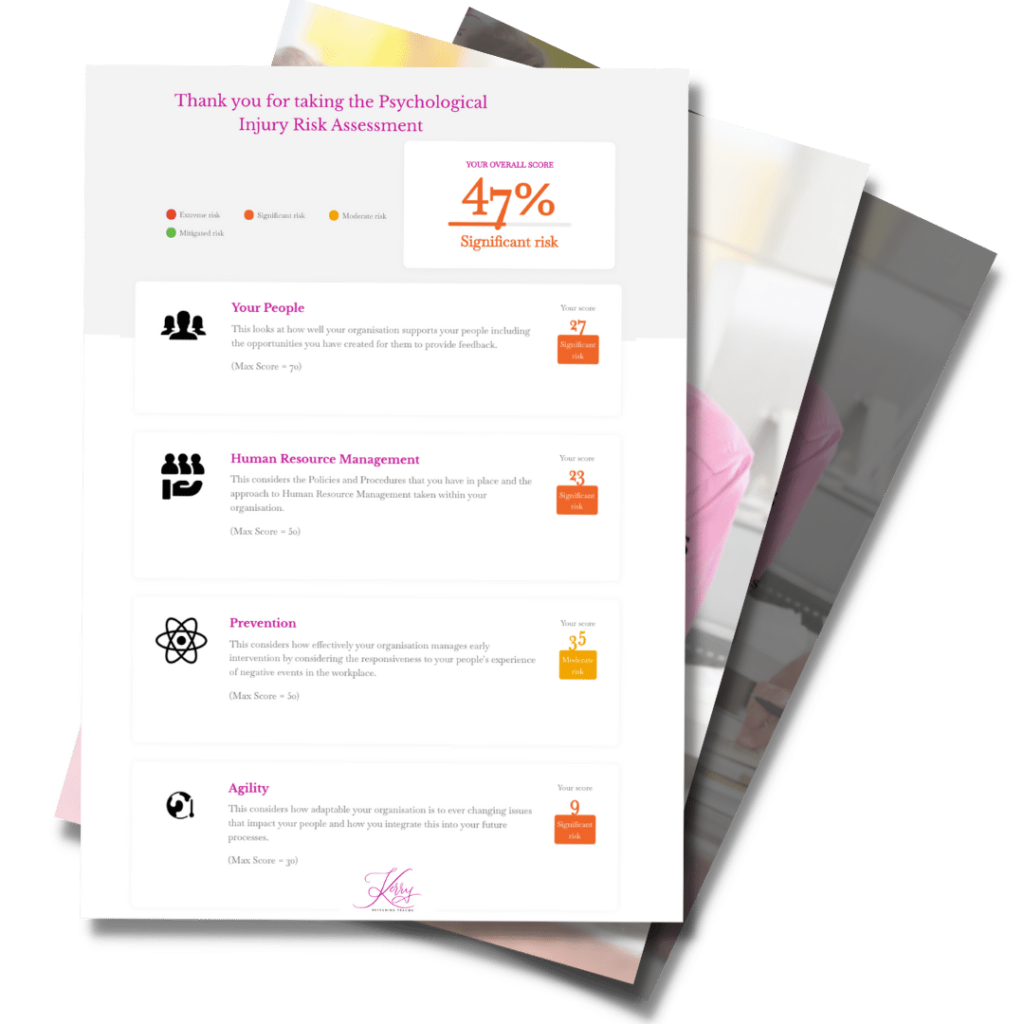
When we are trying to mitigate risk for psychosocial injuries in our business, it is essential to know how your organisation supports your people. It is crucial to your business success that you do. This includes looking at the opportunities you have created for them to provide feedback.
When assessing your risk for psychological injuries, we include questions about ‘Your People’ in our scorecard assessment. It is important to understand how you engage with your people and look at the avenues you have to obtain feedback about how they feel working for your organisation.
Gain Insights Through Anonymous Feedback
It is a useful component to your strategy to obtain anonymous feedback, in addition to other forms of feedback. Asking your people for feedback in a way that enables them to be anonymous provides us with great insight into what they think. The opportunity to be anonymous enables people to feel more confident and tell you their true feelings, as they feel protected by the anonymity. Staff Survey’s are usually anonymous, but your staff survey should never throw you any ‘curve ball’ surprises!
In addition to formal anonymous surveys, you need to provide informal ways of getting the pulse of your organisation on an ongoing basis. This includes multiple open lines of communication that allow people to report concerns in multiple ways. All organisations need reporting processes that are broader than the immediate line manager, especially if the line manager is part of the issue.
We also look into the ‘hidden’ indicators of dissatisfaction, including rates of unplanned leave and capturing information about workers compensation claims. This should include all claims, regardless of whether they are for a physical or a psychological injury.
By assessing rates of leave, we can examine any patterns that may indicate a problem in a particular team or area of your organisation. There is a lot of data in varying systems within your organisation that can be consolidated into an early warning system – the data doesn’t lie.
Presenteeism
The other measure of dissatisfaction is presenteeism, people not being focussed or productive. If you have ways of measuring output, regularly monitoring these will give you insight into an underlying feeling of discontent.
Most work areas will have KPIs, and depending on the work, there are expectations of output. However, depending on the type of work that your business delivers, it can be more challenging to observe lost productivity. At some point, it can be useful to benchmark the time that varying tasks take, so that we can have clear expectations regarding output.
Taking the time to assess output is something that many organisations claim that they “don’t have time” to do. However, as your organisation starts to expand, it is essential that each new role has clear duties and expectation targets for each task. Each role needs to have a clear goal and link into the overall strategic direction of the business, the goal needs to be clear even if the pathway to achievement isn’t yet clear.
A lack of clarity and ownership of the outcomes is guaranteed to create presenteeism in any organisation.
Exposure to Risks and Workers Compensation
If your rates of workers compensation claims are high, do you look at if there are any commonalities? Either particular sections or people in the organisation that are exposing you to more risk? Are there particular work types in your organisation that appear to be a higher risk?
It’s important to know that regardless of the source of the injury, a person can develop a secondary injury if things are not well managed. A physical injury that results in a person being isolated from the workplace, or ostracised in any way, can result in a psychological injury – so these need to be effectively managed.
We have access to a lot of data about our people, but we don’t think about synthesising it to provide us with an early warning system about their health and wellbeing.
Managing Difficult People
Our people are the number one asset in our business. If you fail to look after them you will find it challenging to grow. From making better choices in recruitment processes, to responding quickly to mediate challenges between staff members, there are several areas that we can manage better to reduce the risk of needing to manage difficult people.
I often hear managers lament the time it takes to manage ‘difficult’ people, but perhaps they wouldn’t become problematic if we worked things better. Especially after the past two years of the pandemic, looking after our most significant resource should not be viewed as a chore – it’s essential to the success of your business.
Want to know if your business is at risk? Take our assessment and see your scorecard today.
Reframe . . . Respect . . . Recover!