Tag: prevention

  • Why Supporting Your People is Essential to Your Business

    Why Supporting Your People is Essential to Your Business

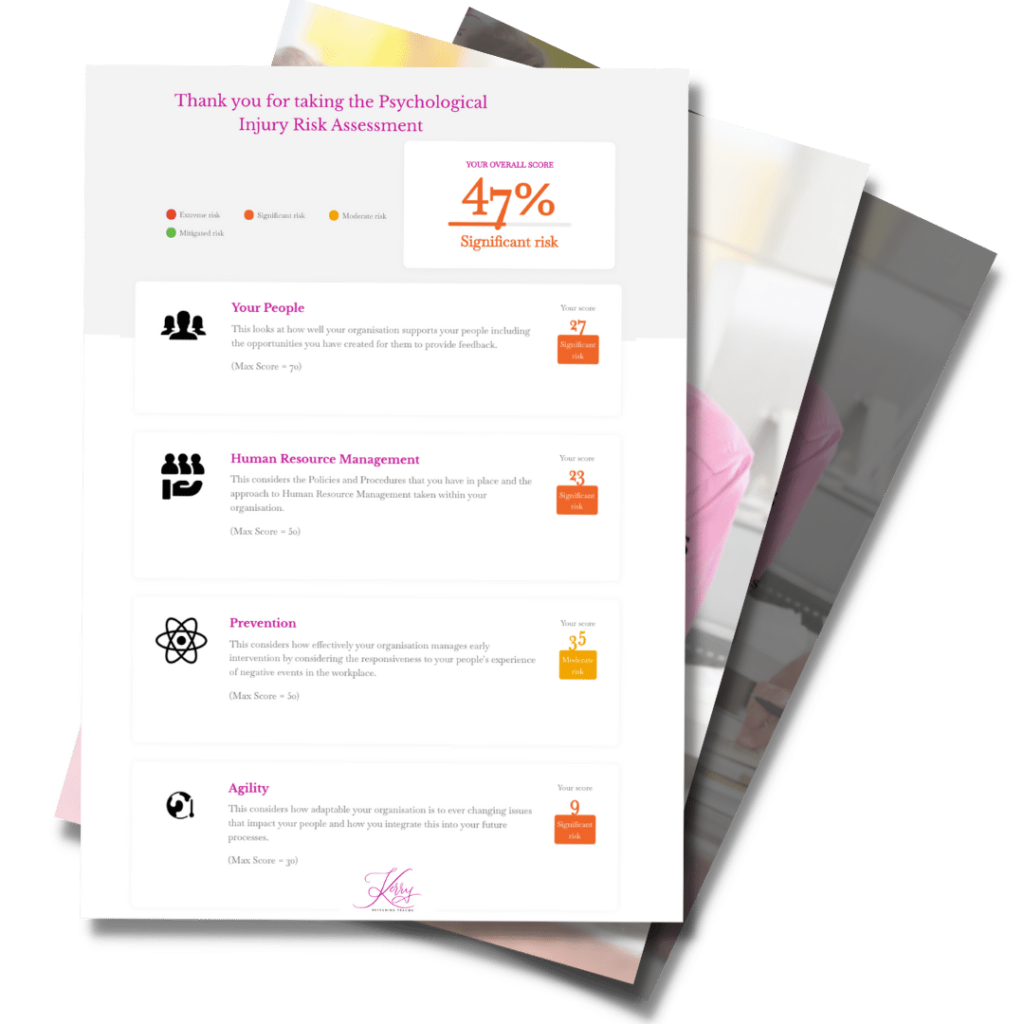
    When we are trying to mitigate risk for psychosocial injuries in our business, it is essential to know how your organisation supports your people. It is crucial to your business success that you do. This includes looking at the opportunities you have created for them to provide feedback.

    When assessing your risk for psychological injuries, we include questions about ‘Your People’ in our scorecard assessment. It is important to understand how you engage with your people and look at the avenues you have to obtain feedback about how they feel working for your organisation.
    Gain Insights Through Anonymous Feedback

    It is a useful component to your strategy to obtain anonymous feedback, in addition to other forms of feedback. Asking your people for feedback in a way that enables them to be anonymous provides us with great insight into what they think. The opportunity to be anonymous enables people to feel more confident and tell you their true feelings, as they feel protected by the anonymity. Staff Survey’s are usually anonymous, but your staff survey should never throw you any ‘curve ball’ surprises!

    In addition to formal anonymous surveys, you need to provide informal ways of getting the pulse of your organisation on an ongoing basis. This includes multiple open lines of communication that allow people to report concerns in multiple ways. All organisations need reporting processes that are broader than the immediate line manager, especially if the line manager is part of the issue.

    We also look into the ‘hidden’ indicators of dissatisfaction, including rates of unplanned leave and capturing information about workers compensation claims. This should include all claims, regardless of whether they are for a physical or a psychological injury.

    By assessing rates of leave, we can examine any patterns that may indicate a problem in a particular team or area of your organisation. There is a lot of data in varying systems within your organisation that can be consolidated into an early warning system – the data doesn’t lie.

    Presenteeism

    The other measure of dissatisfaction is presenteeism, people not being focussed or productive. If you have ways of measuring output, regularly monitoring these will give you insight into an underlying feeling of discontent.

    Most work areas will have KPIs, and depending on the work, there are expectations of output. However, depending on the type of work that your business delivers, it can be more challenging to observe lost productivity. At some point, it can be useful to benchmark the time that varying tasks take, so that we can have clear expectations regarding output.

    Taking the time to assess output is something that many organisations claim that they “don’t have time” to do. However, as your organisation starts to expand, it is essential that each new role has clear duties and expectation targets for each task. Each role needs to have a clear goal and link into the overall strategic direction of the business, the goal needs to be clear even if the pathway to achievement isn’t yet clear.

    A lack of clarity and ownership of the outcomes is guaranteed to create presenteeism in any organisation.

    Exposure to Risks and Workers Compensation

    If your rates of workers compensation claims are high, do you look at if there are any commonalities? Either particular sections or people in the organisation that are exposing you to more risk? Are there particular work types in your organisation that appear to be a higher risk?

    It’s important to know that regardless of the source of the injury, a person can develop a secondary injury if things are not well managed. A physical injury that results in a person being isolated from the workplace, or ostracised in any way, can result in a psychological injury – so these need to be effectively managed.

    We have access to a lot of data about our people, but we don’t think about synthesising it to provide us with an early warning system about their health and wellbeing.

    Managing Difficult People

    Our people are the number one asset in our business. If you fail to look after them you will find it challenging to grow. From making better choices in recruitment processes, to responding quickly to mediate challenges between staff members, there are several areas that we can manage better to reduce the risk of needing to manage difficult people.

    I often hear managers lament the time it takes to manage ‘difficult’ people, but perhaps they wouldn’t become problematic if we worked things better. Especially after the past two years of the pandemic, looking after our most significant resource should not be viewed as a chore – it’s essential to the success of your business.


    Want to know if your business is at risk? Take our assessment and see your scorecard today.
    Reframe . . . Respect . . . Recover!

  • Prince Harry and Trauma

    Prince Harry and Trauma

    Recently I had an article released in The Canberra Times talking about “The Me You Can’t See”, the combined Oprah and Prince Harry mini-series which discusses mental health, including Harry’s own experiences which lead to him taking his wife and family and leaving the UK.

    Back in February, after the Duke and Duchess of Sussex aired their initial interview with Oprah, I prepared an article in response to something I had read in the New York Journal from Bessel van der Kolk, the author of “The Body Keeps the Score”.  Bessel van der Kolk is a psychiatrist who is well-known for his trauma expertise, and normally I would say that he speaks a lot of sense.  I met him in Spain almost a decade ago, and he has previously shared a lot of wisdom in his approach, especially about the physical manifestation of trauma in the body.  However, in this particular article, I was really surprised because Bessel claimed that just because Prince Harry had lost his mother, this was no guarantee that there was any traumatic impact.  I was shocked! I just couldn’t believe what he was saying. 

    Of course, the death of Prince Harry’s mother was going to have a traumatic impact on him

    Prince Harry’s story makes perfect sense.  He hates the UK media with a vengeance because, in his mind, they are the ones that are responsible for his mother’s death. The way he views it, they murdered her.

    Is he ever going to have a great relationship with the tabloid media?  Of course not. 

    The approach taken by Bessel van der Kolk was really surprising.  Sometimes individuals in certain professions spend an awful lot of time trying to validate their intellectual position on it, rather than actually looking at the experiences that people have as reasonable, and expressing empathy for those experiences.

    Harry was watching his wife being chased around by the media, in the same way that they used to pursue his mother when he was a boy.  Is that triggering? Absolutely.  Does it cause issues?  Of course it does! He became distressed, feeling like he was going to lose another woman in his life and he couldn’t protect her. It all makes perfect sense.

    Prince Harry talks about using EMDR Therapy to process his traumatic experiences, making everything feel better

    You can tell that EMDR Therapy has been effective for Harry, especially when you compare the way he speaks in comparison to others, including Oprah and Lady Gaga in ‘The Me You Can’t See’. When Harry speaks about his traumatic experience, his demeanour is quite different to when Lady Gaga, Oprah or others in the series open up about their mental health challenges.  While many can be seen to be still highly emotional about their experiences, Harry is able to recall his experiences calmly and with clarity. That’s not great editing, that is how EMDR Therapy processes the negative emotions associated with the traumatic experience.

    The Duke of Sussex supports that attitude that I have spoken abut for many years, which is the need to support humanity to build mental resilience.  That is the reason I developed the Mental Muscle Method 12-week program looking at building psychological awareness and increased resilience. This method is focussed on how we prepare people for emotional challenges or difficulties and provide them a range of strategies that assist them to build self-awareness to help them move through it and get on with life.

    Reframe . . . Respect . . . Recover!

  • Wellbeing in the Workplace

    Wellbeing in the Workplace

    It is important to have balance in our working lives to ensure that we can maintain a good level of wellbeing.

    What is most important is making sure that organisations are able to support their staff to understand what wellbeing means and to ensure that we put systems in place to support it.

    Part of my own wellbeing during the day is to go outside, take a breather and get away from the constant requirements of the work that I do with clients.  It provides a way of breaking up the day and the constant feeling of pressure we often find in working environments. 

    I am lucky enough to be able to bring my dog to work and take him to the park to play throughout the day.  While I understand that not everyone has that opportunity, that should not stop them from taking breaks.

    We can get caught up in the deadlines and pressures that occur from constantly working. 

    We end up very busy without necessarily being very productive.  Taking some time out and rebalancing the brain by getting outside in the fresh air gives us the ability to reset and not think about what is next on the to do list.

    Wellbeing in general is often a sense of making sure that we are clear on what it is we need to do.  If you work in a really reactive work environment, there is a constant feeling of pressure to do more work and do it quickly, then there isn’t enough time spent planning. 

    One way to manage this is by utilising quadrants and breaking tasks down into how urgent and/or important they are.  A lot of the time, tasks seen as urgent often push their way to the top and therefore are given a priority as also important, when in fact they may just be urgent and not always urgent to you.  The issue here is that tasks with little urgency that are quite important to your role tend to fall off the radar. 

    Often a reactive work environment means that you are not as productive. 

    If you were to better manage your wellbeing by taking small breaks, preferably getting outside or doing something creative, you provide a good balance and allow your brain to refresh.

    There is always something that you may believe requires your immediate attention.  However, that “something” will be there whether you are or not.  Research shows that even a small break away from your normal work set-up has a positive impact on your productivity, so go take that break!

    Even going for a short walk can be incredibly beneficial because when we walk, we engage in bilateral stimulation and that helps our brain to process our challenges – it’s great thinking time!  It doesn’t have to be a long walk, just enough to stretch out your muscles, clear your head and take a moment to do something a little different.

    Reframe . . . Respect . . . Recover!

    Kerry Howard
  • Emotional Vibration and Micromanagement

    Emotional Vibration and Micromanagement

    Micromanage
    /ˈmʌɪkrəʊmanɪdʒ/ – control every part, however small, of (an enterprise or activity)

    In organisations where people feel that they are being micromanaged, not trusted or given autonomy over their work, the vibrational elements of their emotions tend to give off negative vibes.  Similar to that feeling when you walk into a room and you could cut the air with a knife because two people have been arguing. You get this automatic feeling that you don’t want to be there.

    In my most recent book “The Trouble with Trauma”, I talk about how emotions vibrate.  In a workplace, you can notice when you walk into a space that it feels as if the energy is low and quite heavy.  Often people in these workplace’s, will state that they feel quite despondent.  They don’t really have a sense of autonomy over what they are doing, nor do they feel like they are trusted to get on with the job.

    This is where micromanagement becomes a big part of the problem.

    Micromanagement tends to occur because people become overly controlling about things that they want to have happen in the workplace.  Usually individuals feel they’re being let down by other employees, they are not being supported and this can lead to feelings of frustration and ultimately, tighter controls.  This can occur for a whole range of reasons, but some people naturally try to cope with daily stressors by micromanaging their people.

    However, when we take control of the outcomes, impose on other people and go over the top of them to make sure they are doing everything right, they tend to just stop doing anything.  Many times, in trying to manage our own anxiety about getting it right, we imply a lack of trust in the person that we delegated the task to.

    This causes a much bigger problem in the workplace!

    It is about having a better awareness point.  If you can see that you’re getting frustrated and starting to feel as if the work you are assigning is not being completed efficiently, you need to stop and reset.  Think about your communication and what it is that is not getting through correctly. 

    People may feel that what they are doing is not good enough or they are letting people down.  But by the same token, they may not truly understand what is required of them.  Sometimes people don’t complete things because they don’t feel that they have enough clarity to deliver what is required. This is especially true if they have received negative feedback from previously delegated tasks.

    You may need to change the communication pathway, return to the beginning or completely reset.  Sometimes this may require an independent third party.  All they may need to do is hear what both sides are saying and understanding the communication variation.  It is all about perception and sometimes we need to stop and start from the beginning again to work out what the process is.

    Understanding where the communication is breaking down, and learning how to structure it so that both parties are on the same page, is what is needed to rebuild trust.

    If you’re finding yourself getting frustrated with other workers, you may truly benefit from a third party or internal coach within your organisation.  It is a good place to start for someone independent to listen, see both sides, help reset and make a difference.  Make sure that you choose someone with great communication and reasoning skills as it can be challenging to help people to see that the issue is about the process, not the person.

    Reframe . . . Respect . . . Recover!

    Emotional Vibration and Micromanagement
  • Presenteeism vs Absenteeism

    Presenteeism vs Absenteeism


    presenteeism
    /prɛznˈtiːɪzəm/ – lost productivity that occurs when employees are not fully functioning in the workplace because of an illness, injury, or other condition
    absenteeism
    /abs(ə)nˈtiːɪz(ə)m/ – habitual non-presence of an employee at his or her job

    Many believe that the problem with staffing issues from a mental health perspective are about Absenteeism – employees staying at home, not coming to work.  In reality, the biggest impact on our productivity is from Presenteeism – employees turning up to work but not functioning effectively.

    Presenteeism has had a big impact since COVID.  Many people who have been stressed or impacted by changes in their home life feel as if they can’t return to the work environment.  Whilst Australia has not had such a significant experience of COVID-19 as other parts of the world, the sudden change of autonomy resulting in an inability to make plans, or catch up with friends and family, can really start to increase our levels of anxiety and result in ongoing feelings of low mood.

    People are tired! They’re turning up to work, but they are not effectively engaging.  They’re not focussed, cannot stay on task and are not churning out the level of work that they were capable of doing before. 

    It is the Presenteeism that is our biggest concern. 

    I try and encourage organisations to focus on their ability to engage their employees in understanding mental fitness.  We need to build our capability to be able to weather the varying storms and challenges that life throws at us.  If we talk about challenges more openly, we expect that people are going to be more open about their mental health, this bodes much better for a positive work environment. 

    Whether you have a small business or run a large organisation, if you don’t address the issues of people’s mental health, in addition to their physical health, then you are losing an opportunity to help people work more effectively.

    The best way we can do that is by making it okay to talk openly about life’s challenges.  It isn’t possible to separate our work and home lives altogether.  If we are extremely stressed at home then that is going to show in the work we are able to put out.  When we have an employer who is understanding of the fact that life is going to throw everyone curve balls, then we are given the space to be able to recover. 

    Recovering at work is always better than employees being off work.  Recognising that presenteeism in those situations is very real, but understood, will help them get back to their best self as fast as they can.  The culture is set by the attitude that is present when they are being affected by these issues. 

    We try and pretend that our people are not humans – but they are!

    When we treat them like human beings, we accept that what they tell us on face value is right, and that it has had an impact on them, then we give them an opportunity to be honest and open.  We need to ask how we can help them get back to the best that they can be in the work environment.

    In doing so, you create a lot of loyalty, buy-in and support.

    Reframe . . . Respect . . . Recover!

  • Mental Health in the Resources Sector

    Mental Health in the Resources Sector

    The Australian minerals sector has maintained a vigilant focus on workplace health and safety. Historically, efforts were directed toward the identification and mitigation of physical safety risk, and the promotion of workplace culture that aims to prevent injury to the individual or their workmates. Over the past few years there has been a widening of this focus to include the wellbeing and mental health of those working in the resources sector. There is now a strong body of evidence that attention to mental health in industry can bring substantial benefits. This approach has been supported in principle by the Minerals Council of Australia in their 2015 ‘Blueprint for Mental Health and Wellbeing’.

    41% of FIFO workers don’t seek help due to stigma

    The main concern with the approach outlined in this ‘Blueprint’ is that there are a number of areas that have been identified as ‘possible actions that the minerals industry, companies, sites or employees may undertake’. In the past five years, there has been little change in the mental health and wellbeing in the resources sector, mainly because no clear actions were taken. In order to achieve a goal, research shows that you have to ensure that certain criteria are met. The Blueprint provided ideas about improving mental health, but didn’t get into the specifics of ownership for the idea or the specifics of the what, where, when, how, who and why. Without specifics that are measurable, and holding someone to account for them, the chances of success pale into insignificance.

    39% of FIFO workers are stressed by lack of services

    To achieve real and lasting cultural change for the sector, there must be specific interventions clearly identified that provide guidance about exactly what activities are going to result in improved mental health and wellbeing for the cohort. They require a timeframe for achievement and a plan for getting there. These outcomes need to be measured and monitored for ongoing and iterative improvement.

    Mental Fitness

    In fitness, we understand that if a person engages in a 12-week body transformation challenge, they will see many physical and psychological benefits from it. We don’t expect that those benefits will continue if they decide not to maintain their active fitness program and monitor their eating. Yet, we think that if we provide ‘Mental Health First Aid’ or some other one-off training to our people we have ticked the box and they won’t have any ongoing mental health challenges. It’s a ridiculous notion. Maintenance of any skill requires regular use and reinforcement.

    Workplace mental health programs have direct benefits in reducing absenteeism and improving productivity and workplace injury claims, alongside indirect benefits to recruitment, retention and staff wellbeing. Programs that address mental health in the workplace can also bring social benefits to the morale and culture of the workplace and to employees and their families. The wider impact of mental health programs in the workplace should not be underestimated. These pathways contribute to the impact on individual health, wellbeing and functioning and contribute to the delivery of broader health benefits to the community.

    It’s Not Just Stigma

    There is a great deal of focus in the sector that the problems exist due to stigma. Although it may be true that there is a significant level of stigma across the sector, it does not have to be a barrier to help- seeking. In fact, I published research about increasing help-seeking intention in 2018. We can increase help-seeking intention, especially in men, but they need to be hearing the right message.

    Sector Lacks Focus

    Data on mental health needs within the minerals industry is limited. Research in affiliated sectors has been more robust and some of the outcomes can be extrapolated due to their correlation.

    One in five Australian’s report a mental health issue annually, for miner’s it is one in three. That means that there are over 93,000 resources workers (predominantly men) who are likely to be experiencing a mental health issue at any given time. There are several reasons for this including higher than average levels of ex- services personnel, remote working conditions in FIFO/DIDO roles and anecdotal evidence around substance-use. The mental health impacts are not only on the worker, but can have influence on the mental health of their families. The sector employs 2% of the population, but influences over 9% of the population.

    Conservative estimates of cost to the industry including lowered productivity are between $320 million – $450 million per year or around $300,000 – $400,000 annually for an average site. However, these numbers were based on the impact of only 10,000 affected employees. The real number is almost 10-fold.

    The Solution

    In psychological terms we refer to three phases of intervention – promotion, prevention and early intervention. In order to improve the overall mental health of any cohort, we must address all three areas.

    The exact interventions utilised in each area require consideration of each individual work environment. In essence, the first step is to undertake a ‘Traumatic Injury Prevention Strategy (TIPS)’ review. This initial piece of work involves review of relevant documentation, in depth discussions with senior staff and provision of a detailed Report that provides insight into what the risk factors are under each of the four areas (People, HR Management, Prevention and Agility). This report outlines a number of Recommended Actions, including the rationale for why these should be taken, backed up by emerging evidence and research.

    This provides the organisation with an evidence-based roadmap of options for moving forward, including identification of the options that will afford the quickest return on investment, and improve outcomes for your people into the future.

    Recommended actions are aligned with industry specific outcomes combined with the required interventions to ensure that cultural change can be achieved with a clear plan of appropriate timeframes and opportunity for review and iterative adjustments over the course of the project implementation.

    Responsibility is Shifting

    Implications of poorly managed stressors on the workforce have recently come under International scrutiny. In early 2020, two Director’s of a French Company were found guilty of manslaughter for failing to intervene in the bullying and harassment of a staff member who ultimately took his own life. We know that the resources sector has high rates of suicide amongst it’s employees. How long will it be before these corporations are held to account for their failure to even attempt to improve the mental health of their workers?

    Workplace Culture

    Research from Beyond Blue highlighted that a dysfunctional workplace is just as likely to cause a person to develop PTSD as being routinely exposed to traumatic experiences.

    Male dominated workplace cultures do not support their people to express emotion or share the impact of their experiences openly. The only way that these people can maintain active engagement in the workplace, to which they want to belong, is to repress the impact of these experiences. This action requires the expression of the opposite emotion to suppress it, resulting in more aggressive behaviour in the workplace.

    This results in adding further dysfunction to the work environment and over time, this becomes the new ‘norm’ and sets the culture of an organisation.

    Cultural Change

    Awareness
    Learning
    Practice
    Accountability

    Individual corporations need to ensure that these elements are in place, they they want to improve culture and enhance the mental health and wellbeing of their people.

    Reframe . . . Respect . . . Recover!